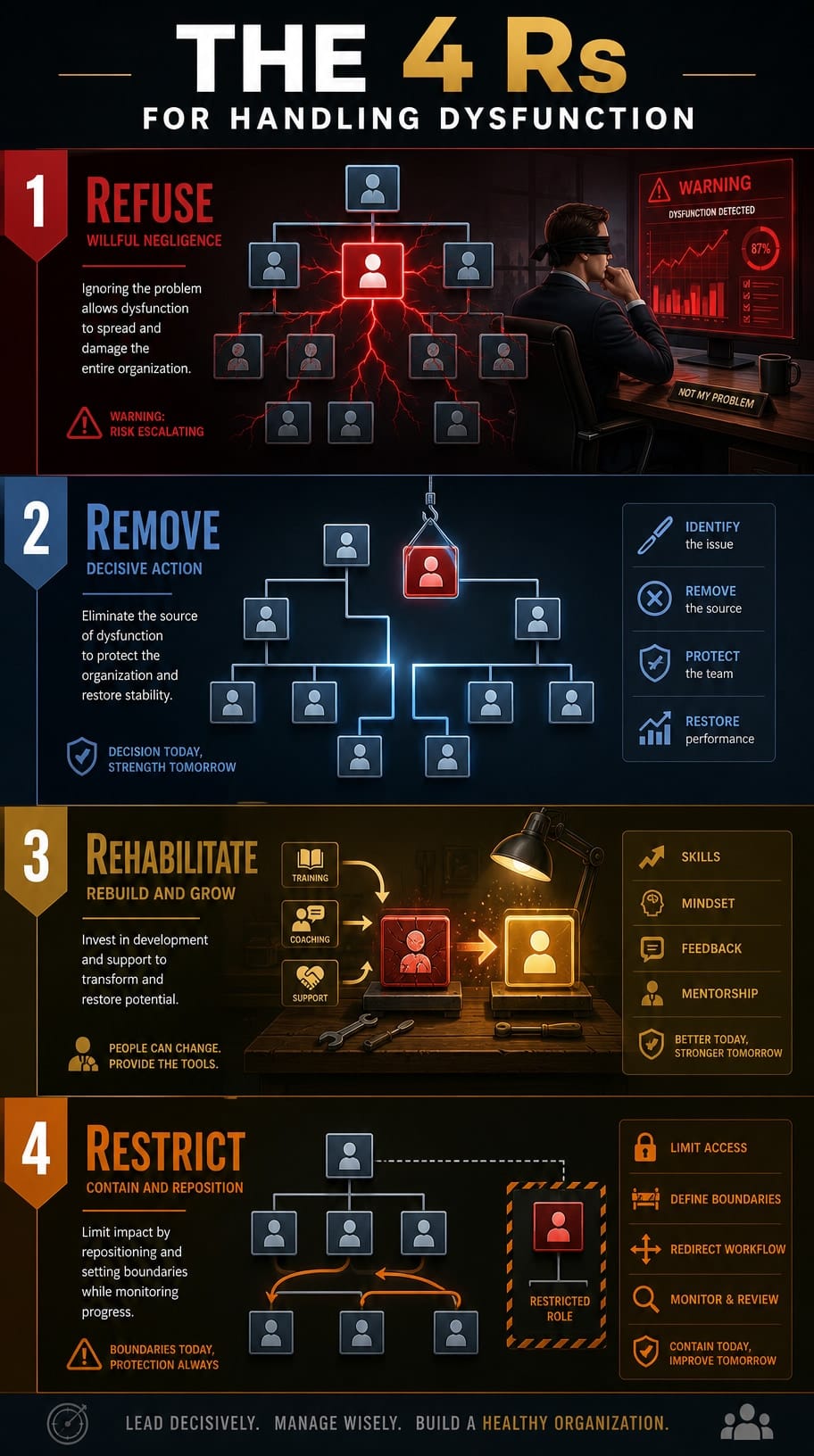
When something in the operation is broken, a process, a role, or a person, you have four ways to respond. Three of them move you forward. One quietly costs the most, and it is the one most organizations choose without deciding to.
1. Refuse / Refrain
The insane option
The first response is to do nothing. You see the dysfunction, you feel what it is costing you, and you leave it in place anyway.
This is the option that looks like patience and is really avoidance. Left alone, dysfunction compounds. Efficiency drops, good people burn out, morale erodes, and the problem you could have named early becomes the problem that defines the culture. It is the insane option because it ignores the root cause and lets the damage run, usually until it costs far more than the fix ever would have.
2. Remove
A sane option
The second response is to take the source of the dysfunction out of the system.
If it is a person, that can mean letting them go or moving them out of the seat where they are doing harm. Sometimes it is the people harmed by the dysfunction who remove themselves, they leave, and you lose them. If it is a process, you end it or replace it with one that works.
Removal resolves the issue fast and can restore the team almost immediately. It also carries cost: disruption, the hiring and training to backfill, and a hit to morale if it is handled badly. It is a sane option because it addresses the problem directly instead of tolerating it.
3. Rehabilitate
A sane option
The third response is to fix what is there rather than remove it.
For a process, that means redesigning it: rewriting the procedure, adding the right tool, changing the workflow. For a person, it means retraining or developing them, through coaching, support, and a clear path to the standard the role actually requires.
Rehabilitation is the slower, more constructive route. It builds skill, builds resilience, and builds a culture where problems get corrected instead of discarded. It is the right call when the underlying material, the process or the person, is worth investing in.
4. Restrict and Reposition
The transitional move
Sometimes you cannot remove the dysfunction yet, and rehabilitation is still in progress. That is where the fourth R comes in.
Restrict the role so its impact on the team is contained: fewer critical tasks, less exposure to the rest of the operation. Reposition the person into a seat where the potential damage is minimized while the retraining plays out.
One more caveat: people usually feel it when they are being restricted or repositioned, and some will retaliate. A person who senses they are being sidelined can push back, poison morale, or do real damage on the way out. This option has its own ceiling. Use it as a short, deliberate bridge with a clear end in mind, not as a place to quietly park a problem and hope it resolves itself.
This is a bridge, not a destination. It buys stability while you work toward a real resolution. It also comes with a hard rule: if the behavior or performance does not improve, restriction and repositioning quietly expire, and the only sane option left is removal.
The one to never default to
Refusing to act is the single response that guarantees the problem grows. Everything else, removing it, rehabilitating it, or restricting and repositioning while you decide, at least moves the operation toward health. The job is to pick one on purpose, not to let the insane option win by default.