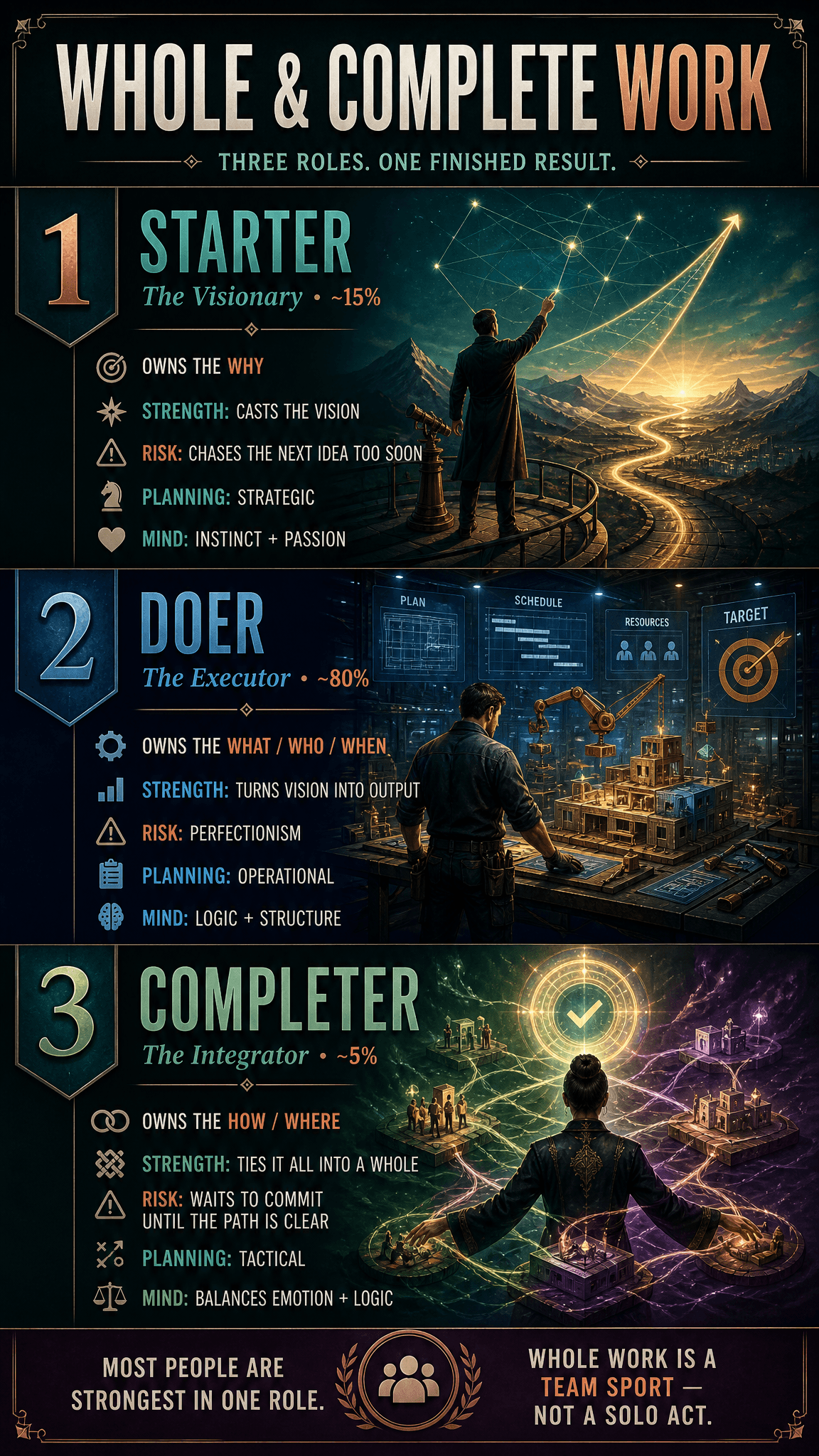
Every finished piece of work passes through three sets of hands: someone who starts it, someone who does it, and someone who completes it. Get all three in the right seats and work flows. Miss one, or put a person where they do not belong, and the whole thing stalls. This is the Theory of Whole and Complete Work, and it begins with knowing which of the three you are.
The Starter
The Visionary, about 15% of people
The Starter owns the why. They are the visionary, the game maker who dreams up where all of this is going.
StrengthCasting the vision, the reason the whole thing exists.
WeaknessShiny object syndrome, the pull toward the next big idea before the last one has been completed.
The tellA great Starter separates the genuinely possible from the impossible. A weak one keeps chasing the impossible.
ViewpointSky's the limit.
PlanningStrategic, the long-range direction and the big-picture goals.
ApproachProactive by dreaming, out ahead of everyone else.
MindLeans emotional-mind, led by instinct, passion, and gut feel for what could be.
The Doer
The Executor, about 80% of people
The Doer owns the what, the by-who, and the by-when. They are the executor, the game piece that turns the vision into something real.
StrengthTurning the vision into real, finished output.
WeaknessPerfectionism, polishing details long after the work was already good enough to hand to the next stage.
The tellA great Doer is competent, with the specific knowledge to get their part done. A weak one lacks the skills, and the ability to be trained into them.
ViewpointWorks at ground level, toward specific targets.
PlanningOperational, the short-term day-to-day execution of who does what by when.
ApproachProactive by doing, hands-on and making it happen.
MindLeans logical-mind, led by facts, needs structure and instructions for what the task in front of them requires.
The Completer
The Integrator, about 5% of people
The Completer owns the how and the where. They are the integrator, the game player who ties the pieces together and carries the vision across the line.
StrengthTying the pieces into one cohesive whole and carrying it across the line.
WeaknessToo practical to commit until they can see both the starting components of the starter's vision and the end-game solutions they would contribute.
The tellA great Completer is relentless, and gets more driven the harder the challenge, especially once they can see the path to completion. A weak one is weak-willed and gives up easily, lacking the flexibility of mind to resolve what comes up.
ViewpointThe 40,000-foot view, looking down and connecting the dots.
PlanningTactical, the medium-term steps that connect strategy to execution.
ApproachProactive by aligning, keeping the moving parts in sync.
MindBalances emotion and logic, which is the wise-mind, since they know how to situationally balance what is needed to reach completion.
Which one are you?
Most people are strong in one of the three and passable in a second. Almost no one is genuinely all three, and that is not a flaw. It is the entire point. Whole and complete work is a team sport, not a solo act.
Why all three matter
Each role is essential, but only at the right stage. Starters spark the ideas, and then need execution behind them. Doers bring the ideas to life, and then have to keep adapting instead of defaulting to whatever already works. Completers refine the work and carry it across the line, but they should not be the only ones generating ideas.
Put the three in harmony and work moves. Misplace them and you get friction, stagnation, or quiet failure, which is exactly what part two is about.
Continue the series Part 2: When Roles Get Misplaced →