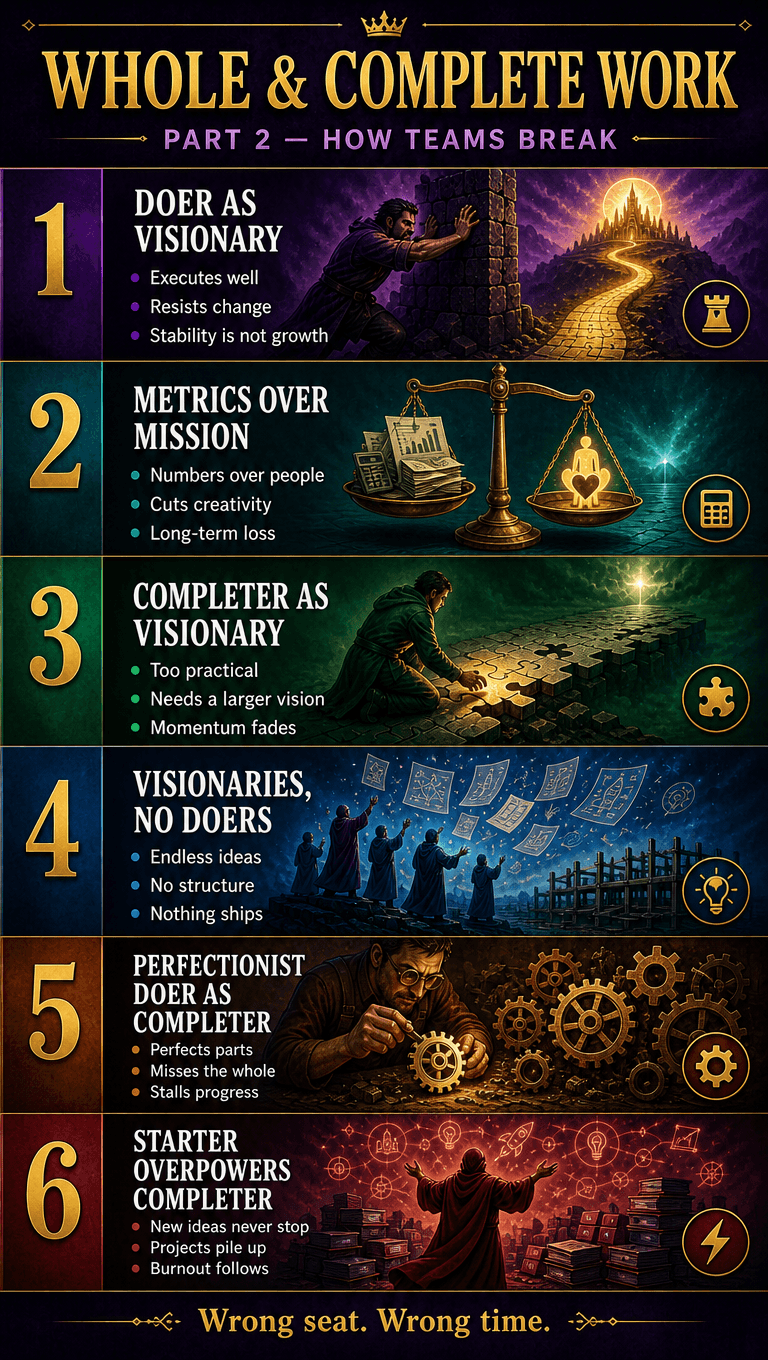
In part one we laid out the three roles: the Starter, the Doer, and the Completer. The theory only holds when each plays their part at the right moment. When roles get misplaced, teams hit inefficiency, stagnation, or outright failure. Here are six of the most common ways it goes wrong.
1. A Doer trying to be the Visionary
A Doer thrives on execution and stability, not on invention. That can be the right hand at the wheel when the company is in good order and just needs to maintain what works. However, put them in charge of new strategy and they resist change, defaulting to what already works, sure there is no need to be ahead of the curve even when others have proven it. A software team led this way sticks with an aging but reliable tech stack and will slowly lose its edge. Stability is a maintenance skill, not a growth one.
2. A metrics-driven Doer running everything
An executor who leads purely by the numbers prioritizes cost-cutting over creativity and morale. That can be a real save when costs have gotten out of hand and someone who reads the numbers pulls the finances back to healthy. But past that point it only looks profitable in the short term. The slashed research budget kills the innovation pipeline, the trimmed perks quietly erode the team, and productivity follows them down. A metrics culture optimizes what it can count, and a mission-driven community runs on what it cannot.
3. A Completer forced into the Visionary seat
Completers refine and connect, bringing focus, speed, and depth to the challenges they solve. That is a strength when a chosen direction just needs tightening and better execution. But in the visionary role they are too practical for the creativity behind the largest ideas, the ones that move communities from the heart. They still have vision for their own solutions once they can see the pieces in play, they are just rarely the source of the big, emotional spirit that pulls everyone forward. Without a larger vision above them, there is no next big goal to reach for, so they lose their drive and their teams disband to seek it elsewhere.
4. Visionaries with no Doers
A room full of Starters generates endless ideas, and early on that energy gets a thing off the ground and attracts belief. But with no structured Doer, the vision stays theoretical, they brainstorm disruptive concepts forever and never ship, and it fails before it launches. Their self-belief runs so high they over-value the idea even without a team to execute it. They keep waiting for the right people to fall in love with it, and it slowly turns to vaporware. Ideas do not compound, shipped work does, and the same idea with a little execution behind it would win.
5. A perfectionist Doer in the Completer role
An executor obsessed with precision keeps the details clean, which matters where quality and consistency are the product. However, in the Completer's seat they get stuck optimizing small parts instead of making it all work as a whole, so a COO buried in daily operations misses the bigger picture and collaboration between departments quietly breaks down. Completing the whole is a different job than perfecting a part. Chasing precision everywhere breaks the 80/20 rule, where roughly 80 percent of results come from 20 percent of the effort. Most work only has to be good enough, and few jobs truly need a perfectionist at every step.
6. A Starter overpowering the Completer
A strong-willed visionary who keeps introducing new ideas can be a gift in the early, formless stage when the direction is still being found. However, once things need to land, they never let a project conclude, instead piling new projects on top of the unfinished ones. This is the founder who keeps shifting the business model, so the company never refines its operations, and the result is instability and burnout for the company and the team. At some point the job stops being about casting more vision and starts being about finishing what's already started, and they can't make that shift.
The pattern underneath
Every one of these failures is the same mistake wearing a different costume: the right person in the wrong seat, or the right person acting at the wrong time. The fix is not necessarily better people. It is knowing which role each person actually plays, and letting them play it.
Starters spark, Doers execute, Completers finish. Balance the three, at the right time and in the right place, and the work finally becomes whole and complete.
Start of the series ← Part 1: The Starter, the Doer, and the Completer