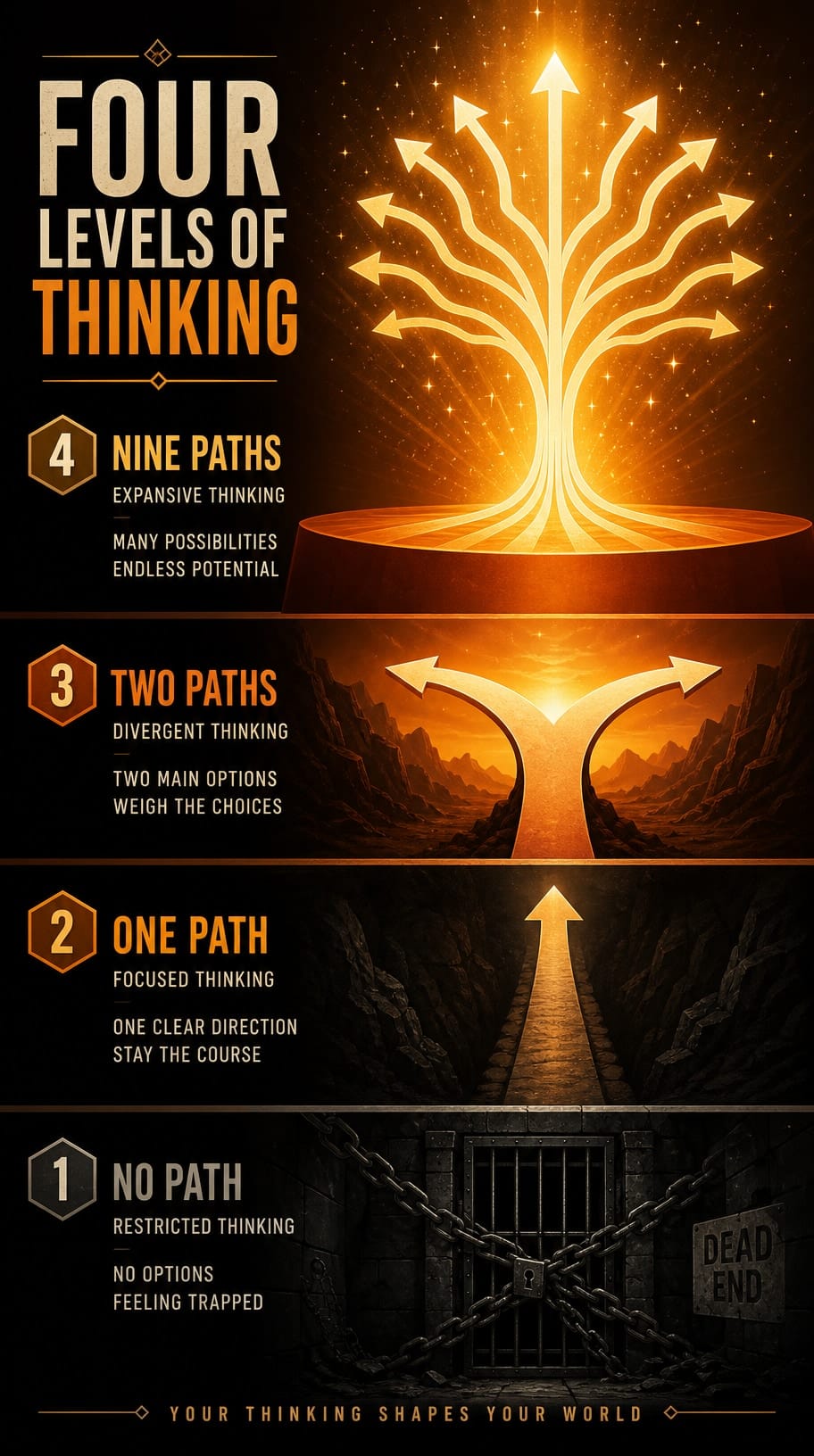
Level 1: Double Bind
"There Is No Way To Go" (Only Death)
A Double Bind is the classic psychological term for a "Catch 22". You're damned if you do and you're damned if you don't -- "There Is No Way To Go" (Only Death). Double Binds are constructed when multiple rules or conditions are an "Entrapment" imposed on a situation or a relationship and are not prioritized in such that these rules conflict or cancel one another out causing a stalemate or inaction leading to the "Entrapped" being controlled, harmed, or destroyed. Double Binds are imposed by the assumed equivalence of at least two rules. Double Binds disappear when the hierarchy of the rules is determined.
Level 2: Slavery
"One Way To Go"
Slavery is when there is only "One Way To Go" because they are owned by a Master. The Master retains the Slave through methods of control like fear and applies bare minimum effort to keep the Slave alive.
Level 3: Either or Thinking
"Two Ways To Go"
Either or Thinking is when there are "Two Ways To Go" that are exclusive of each other. Ultimatums, which don't necessarily lead to death, are a type of Either or Thinking.
Level 4: Being Truly Creative
"9 Ways To Go"
Being Truly Creative is understanding assumptions and, "Yes And Thinking" ("9 Ways To Go"). When employing "Yes And Thinking", it does not invalidate a point of view, but it does place it in relative position with other possibilities and it enables a person to create decision trees that map out a series of logical consequences that predict outcomes. From hypothesis and theory come strategic plans and real actions that can be tested for results either affirming or invalidating theories. From this type of thinking, reality can be perceived for that particular situation, time, and place.